
 Visitors

This modular assistive system enables individuals with limited hand function to perform daily activities independently using a dedicated, customized handle tailored to their grasp characteristics. People with reduced hand strength or mobility due to brain lesions or spinal cord injuries often struggle because everyday tools differ widely in handle size and shape.
The system consists of an ergonomic handle optimized for the user's hand and interchangeable adapters that interface with various assistive and everyday tools. It features an intuitive, one-touch mechanism: sliding an adapter into the handle slot engages a secure push-to-lock connection, while pressing an external button enables quick release. This allows users with weak grip strength or limited fine motor control to exchange adapters independently without assistance, enhancing independence in ADLs.
A variety of handles corresponding to natural hand shapes (spherical, disc, and hook) and practical adapters (can openers, powered wheelchair joysticks, and more) are freely accessible via the "Open Platform." Users can also propose custom handle or adapter concepts through the Open platform, fostering a sustainable, continuously expanding assistive technology ecosystem driven by user demand.

The Assistive Switch is an adaptive input device designed for individuals with limited hand function or difficulty accurately targeting conventional buttons or switches. It enables users to activate connected devices with minimal and imprecise movements, thereby improving accessibility and ease of use.
The activation surface is designed to provide consistent responsiveness across the switch. Users do not need to press the exact center; activation can also be achieved by pressing the edge or other off-center areas. This feature is particularly beneficial for users with a limited range of motion, reduced motor control, or difficulty performing precise hand movements.
The device is available in two sizes, with diameters of 12.7 cm and 6.5 cm, allowing users to select an appropriate size according to their physical abilities, range of motion, and intended application. It is also compatible with standard smartphone and tablet mounting systems users may already own, enabling flexible positioning and adjustment without requiring a dedicated mounting system.
Through an AUX cable connection, the switch can be connected to a variety of compatible devices, including augmentative and alternative communication (AAC) devices, switch-adapted or modified toys, and scanning systems. This allows the device to support a broad range of activities, such as communication, play, learning, and interaction with digital or assistive devices. Its adaptable design and compatibility with existing equipment enable users to configure the switch according to their individual needs and everyday environments.
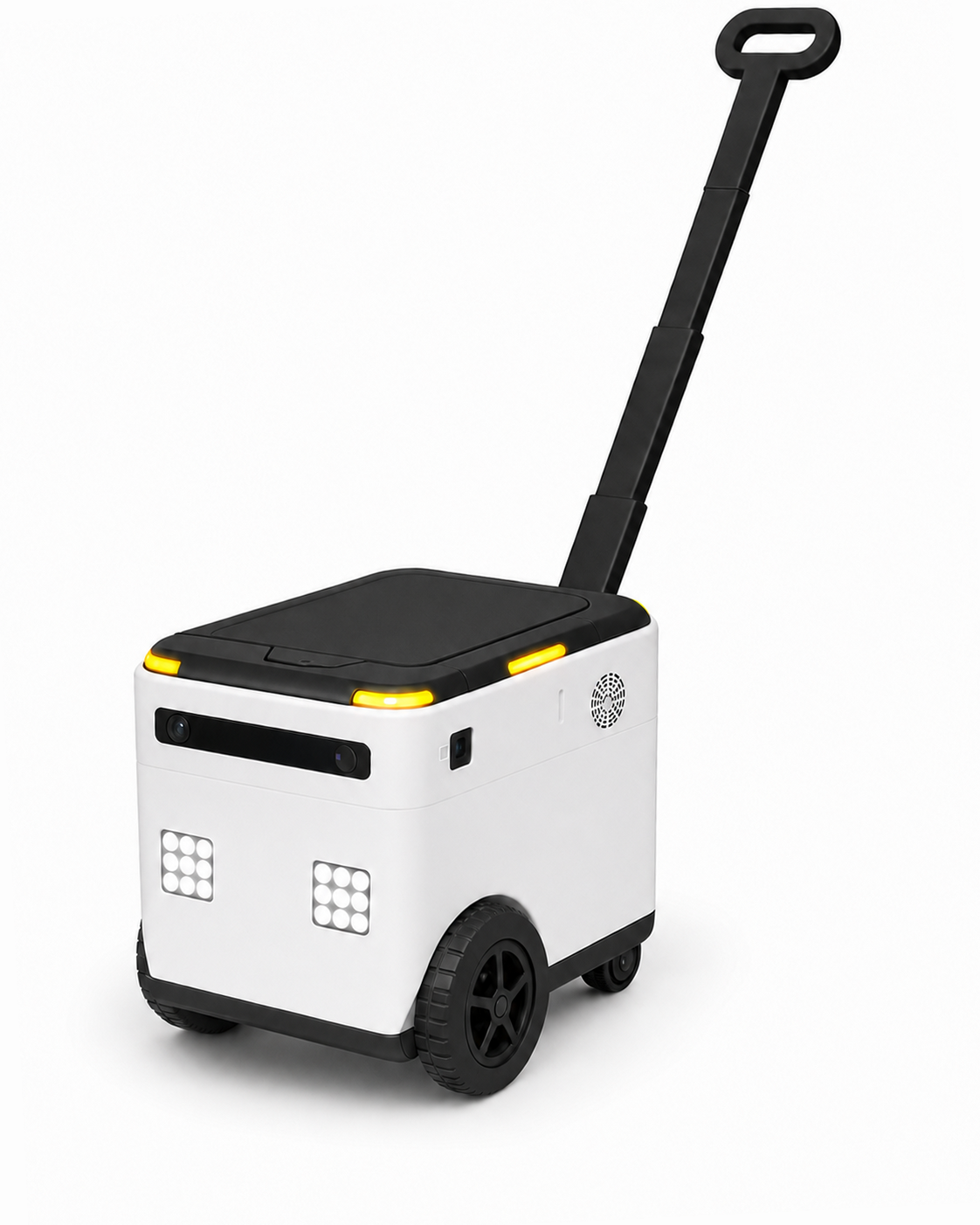
Bedivere is a self-propelled robotic guide that leads from the front, so that people who are blind or have low vision can walk to their destinations safely on their own. Getting started takes nothing more than speaking a destination and taking hold of the handle; from there, Bedivere moves at its user's walking pace. The ring-shaped handle carries every change of direction and speed straight to the user's hand, so even first-time users can follow along easily after a brief orientation. On the move, Bedivere's own bio-inspired AI vision, robust even in unstructured environments, scans a full 270 degrees in real time, responding swiftly to sudden hazards and slowing or stopping when needed to protect the user. Its route is synced just once, at departure; from then on, it navigates using its onboard systems without relying on a network connection, so a dropped signal never interrupts guidance. With no dedicated infrastructure to install, rehabilitation and care facilities can put Bedivere to work right away, and it suits shared, facility-level operation as well as personal use. Bedivere keeps proving itself in real-world use through trials with community rehabilitation centers and schools for the blind across Korea, and with the San Francisco nonprofit LightHouse for the Blind and Visually Impaired.
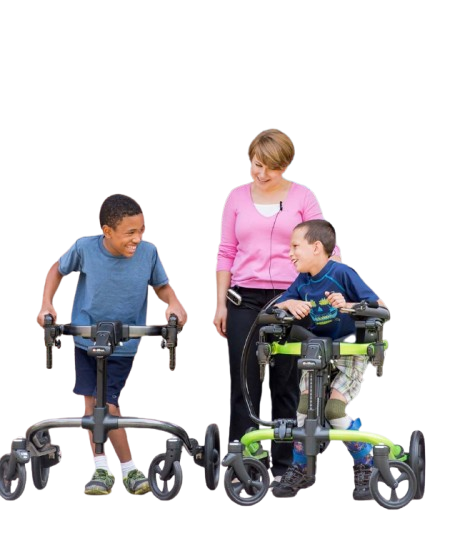
The Rifton E-Pacer combines a powerful electric lift column and torso support with the Classic Pacer’s core gait training features
- Comfortable position changes: Allows users to move from sitting to standing and from seat to seat without assistance from a caregiver
- Extendable base: Allows for leg width adjustment for clients who require a wider stride or when positioning close to a wheelchair prior to transfer
- Accommodates larger users: Supports users up to approximately 196 cm in height and 159 kg in weight
- Weight-bearing measurement: Tracks weight-bearing progress over time using a Bluetooth scale and the Gait Tracker app

AHNAcare is a third-generation electric patient transfer robot (patient lift) independently developed by RKnDmed Co., Ltd. It is an innovative patient transfer solution that combines the strengths of conventional sling lifts and sit-to-stand lifts.
Featuring our patented Open-Arm and Double Hugging mechanisms, AHNAcare is designed to support a wide range of users, from bedridden patients to those undergoing rehabilitation. It enables a single caregiver to safely and efficiently transfer patients between beds, wheelchairs, toilets, chairs, and other locations with minimal physical effort.
While conventional patient lifts focus primarily on transferring patients, AHNAcare delivers Therapeutic Mobility that preserves patient dignity. It minimizes the risk of falls, reduces musculoskeletal strain and workplace injuries for caregivers, and seamlessly integrates daily care activities such as rehabilitation, toileting, and bathing into the transfer process.
In addition, AHNAcare features an IPX6-rated waterproof design, a compact footprint, a 150 kg safe working load, and a 10-level body adjustment system, making it suitable for hospitals, long-term care facilities, rehabilitation centers, and home care environments.
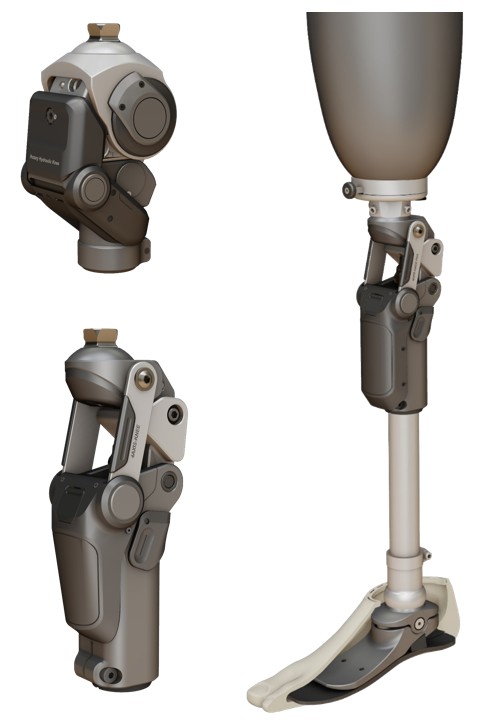
We produce transfemoral prosthesis that can be utilized in medical, rehabilitation, and daily life for people with lower limb amputations. A transfemoral prosthesis is an artificial limb that is fitted to restore the form or function of a thigh amputated in an accident, disease, or war, and is used to alleviate the patient’s functional and mental problems by replacing a part of the lost body with an artificial limb.
We also produce the followings: biomimetic shortened ankle prosthesis, rotating adapter for Korean sedentary lifestyle, pneumatic transfemoral prosthesis, rotary hydraulic transfemoral prosthesis, an electronically controlled multi-axis linkage pneumatic control transfemoral prosthesis, and design and production of an inspection jig(ZIG) required for transfemoral prosthesis production.
