
 Visitors

제니코그(Zenicog)는 임상적 유효성이 검증된 AI 기반 인지·언어재활 소프트웨어(SaaS) 플랫폼입니다. 치매 및 경도인지장애(MCI)를 겪는 고령층과 발달지연 아동을 위해 9개 인지·언어 영역에 걸친 16,000여 개의 맞춤형 훈련 콘텐츠를 제공합니다. 제니코그의 가장 큰 차별점은 독보적인 임상적 근거입니다. 다기관 무작위 대조 임상시험(RCT) 결과, 중재군의 93.9%가 정상 인지 범위(MMSE 27점 이상)로 회복되는 10.4%의 유의미한 종합 인지기능 향상을 입증했으며, 이는 저명한 SCI급 국제학술지(Frontiers in Neurology)에 게재되었습니다. 또한, AI가 환자의 수행 데이터를 분석해 훈련 난이도를 자동 조절(정·오답 예측 정확도 90.8%)하며, 기관용 관리자 웹과 가정용 모바일 앱을 원활하게 연계하여 B2B2C 기반의 연속적인 치료 환경을 제공합니다.

ETHISYNC’s Intervention Training Data Collection System is a platform that standardizes, collects, and manages clinical data generated during therapy and training for children with developmental delays, while supporting personalized intervention. Therapists can record correct and incorrect responses, prompting levels, and problem behaviors in real time during each session and monitor progress toward treatment goals. Ontology-based data integration and normalization technology enables data from assessment tools, diagnostic devices, and external applications to be integrated into a standardized clinical schema, allowing longitudinal management of each child’s developmental trajectory. The Agentic AI module analyzes patterns such as stagnation, regression, and mastery, and proposes program adjustments including difficulty level, treatment goals, and prompting strategies together with supporting evidence. These recommendations are applied only after therapist review and approval. Administrator dashboards and parent-facing progress reports further support the sharing of treatment status and developmental changes, creating a data-driven intervention environment that connects diagnosis, intervention, and home-based care.

ETHISYNC’s Autism Spectrum Disorder Diagnostic Support System is a digital healthcare solution that uses non-contact eye-tracking technology to collect and analyze gaze and oculomotor behavior while children view visual stimuli. The system quantifies fixation patterns and gaze transition characteristics across key areas of interest, including faces, eyes, mouths, people, and geometric stimuli, and provides objective indicators associated with autism spectrum characteristics. During the assessment process, quality metrics such as calibration accuracy, viewing rate, and valid data ratio are monitored to improve analytical reliability. The results are designed to support clinicians as supplementary information alongside existing clinical assessments. By using a non-invasive and contact-free approach, the system minimizes the burden on infants and children and aims to establish a data-driven assessment environment that can be extended from early screening and diagnostic support to continuous monitoring of developmental changes.
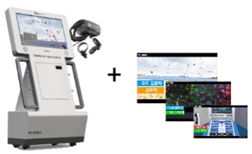
BTCARE is a wellness solution that combines VR-based cognitive activity content with AI-powered behavioral data analysis. Through everyday-life simulations, such as finding items in a virtual supermarket, selecting target stimuli, completing virtual cooking tasks in the correct sequence, and navigating virtual spaces. It collects performance data related to memory, attention, executive function, and spatial cognition.
BTCARE analyzes data generated through the HMD, including response time, accuracy, error count, gaze patterns, and head movements. It then automatically classifies results and performance levels by cognitive domain and provides personalized outcome reports and management information for institutions.
The solution offers beginner, intermediate, and advanced difficulty levels, along with practice, assessment, and training modes. Its senior-friendly UI/UX enhances accessibility and ease of use, making it suitable for welfare centers, senior care institutions, and health promotion facilities.
Positioned as a consumer wellness product rather than a medical device, BTCARE is pursuing overseas field validation and commercialization through multilingual interfaces and locally tailored content.
